By Hamza | Updated 22 November 2026 | Solar Ka Ghar
A hybrid solar system combines rooftop solar panels with an inverter that can manage more than one power source, usually solar, the electricity grid and a battery. For a Pakistani household, that can mean using solar during the day, storing some surplus energy for later and keeping selected appliances running during a grid outage. But a hybrid setup is not automatically the best choice for every home. The right design depends on what you want to keep running, how long you need backup and what the complete system costs.
Quick answer: Choose a hybrid inverter and battery when backup and control over stored solar energy are important to your household. Size the battery from essential appliance loads and required hours, not from the total size of the solar array. Compare the battery’s usable energy, inverter limits, warranty and replacement cost before deciding.
What is a hybrid solar system?
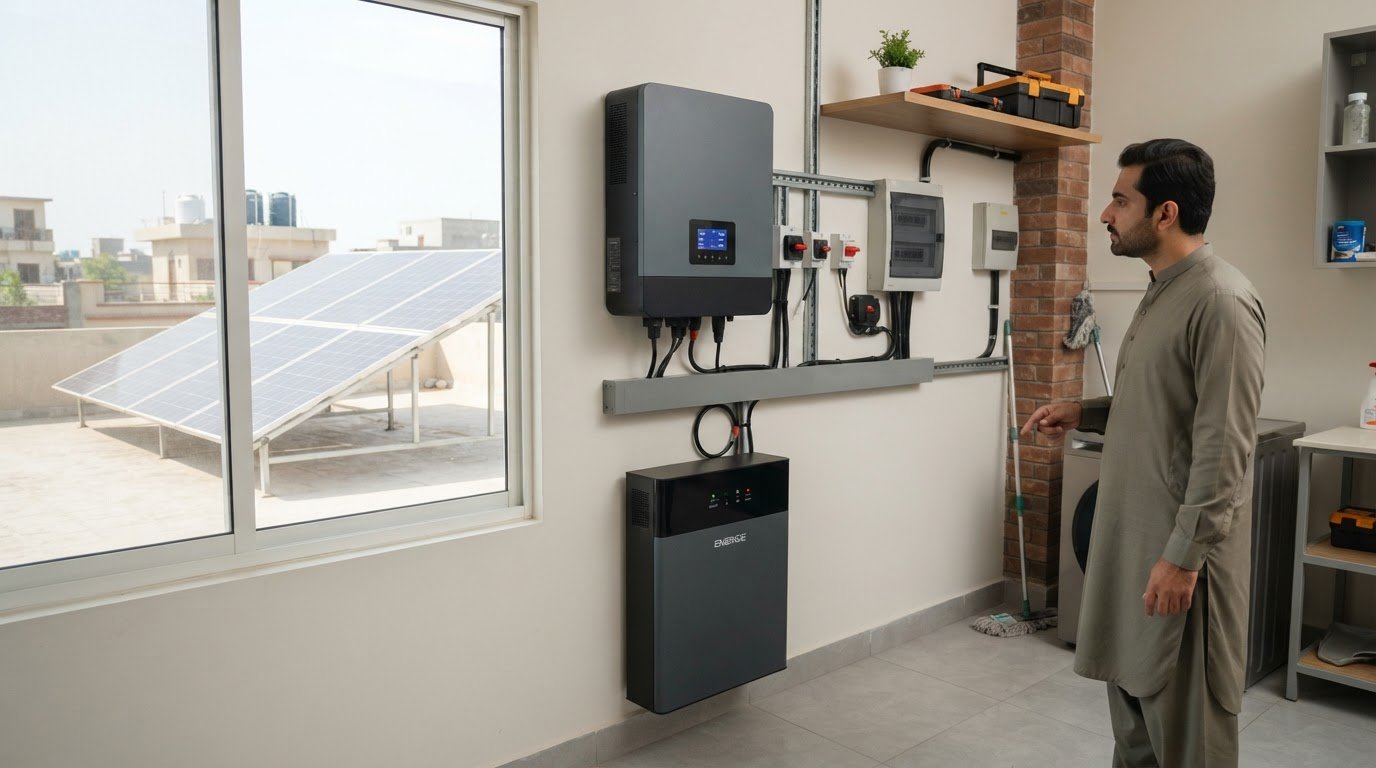
A typical hybrid installation has four main parts: solar panels, a hybrid inverter, a battery and a connection to the utility grid. Panels produce direct-current electricity. The inverter converts and manages power for household appliances, while also coordinating charging and discharging of the battery. Depending on the model and wiring, the system can use solar first, charge the battery, draw from the grid or supply selected loads from stored energy.
The exact behaviour is model-specific. Some hybrid inverters have a dedicated backup or essential-load output, while others require additional equipment or a carefully designed changeover arrangement. Some systems can operate with solar during a daytime outage, but only if the inverter supports that mode and the installation is configured correctly. Never assume that panels alone will keep a normal grid-tied inverter running when the utility supply fails.
Hybrid, on-grid and off-grid: what is the difference?
| System type | Main purpose | Battery | During a grid outage |
|---|---|---|---|
| On-grid | Use solar alongside the utility supply and export surplus where approved. | Usually no battery in a basic setup. | Many standard grid-tied inverters shut down for anti-islanding safety. |
| Hybrid | Coordinate solar, grid and battery storage. | Can include battery storage. | Can power a designated backup circuit if the inverter, battery and wiring support it. |
| Off-grid | Operate without relying on a utility connection. | Usually essential. | Designed to run from solar and storage, with generator support if included. |
A hybrid system is often attractive where outages are disruptive or where a household wants to use more of its daytime solar generation after sunset. An on-grid system may be simpler and less expensive if backup is not needed and the home can use power during the day. Off-grid systems need careful design because there is no utility supply to cover long periods of low solar production.
Start with the appliances you want to back up
Before asking for a battery quotation, write down the appliances that must work during an outage. For many households, this could include a few lights, ceiling fans, a Wi-Fi router, a refrigerator and perhaps a television or computer. Air conditioners, electric heaters, irons, water pumps and electric cooking appliances can add substantial load and may require a larger inverter and battery.
| Appliance example | Illustrative running load | What to consider |
|---|---|---|
| LED lights | A few watts each | Count how many lights will be on together. |
| Ceiling fan | Varies by model and speed | Use the rating label; inverter fans may draw less. |
| Wi-Fi router | Usually a low continuous load | Include its full backup duration. |
| Refrigerator | Variable; compressor cycles | Starting surge and actual energy use matter. |
| Water pump | Can be a high starting load | Check motor rating and inverter surge capability. |
| Air conditioner | Depends on capacity and efficiency | Often changes the battery and inverter budget significantly. |
These are categories, not guaranteed wattage figures. Read each appliance’s rating plate or manual and ask a qualified installer to measure the actual load where necessary. Also consider which appliances will operate at the same time. The sum of every appliance in the house is not necessarily the backup load you need.
How to estimate battery capacity
Battery sizing begins with energy, measured in kilowatt-hours (kWh), rather than just the battery’s advertised voltage or amp-hour figure. Multiply the power of each essential appliance in kilowatts by the number of hours it needs to run. Add the results to estimate the energy requirement. Then account for the battery’s usable capacity, inverter conversion losses, temperature, ageing and the manufacturer’s recommended operating limits.
For example, if selected essential appliances together average 500 watts and you want them to run for four hours, the basic energy requirement is 0.5 kW × 4 hours = 2 kWh delivered to the appliances. The battery may need a higher nominal capacity because not all stored energy is available at the AC outlets and the battery should not necessarily be discharged to zero. The installer should show these assumptions on the design sheet.
A battery’s usable capacity is not always the same as its nominal capacity. Ask the supplier to state both figures and explain the permitted depth of discharge. Also check whether the inverter can supply the required continuous power and handle short starting surges from motors and compressors.
What battery chemistry should you compare?
Lithium iron phosphate (LFP or LiFePO4) batteries are commonly considered for stationary home storage because of their thermal stability and cycle-life characteristics. Lead-acid batteries may have a lower initial price in some cases, but their usable capacity, maintenance needs, charging behaviour and service life differ. Do not compare two batteries by price alone.
- Usable energy in kWh, not only nominal capacity.
- Continuous discharge power and short-duration peak or surge rating.
- Permitted depth of discharge and round-trip efficiency.
- Cycle-life conditions and the capacity-retention warranty.
- Calendar warranty, operating temperature and ventilation requirements.
- Battery management system (BMS) protections and inverter compatibility.
- Local service, replacement availability and warranty claim process.
How to choose a hybrid inverter
The inverter must suit both the solar array and the loads you expect it to supply. Check the permitted PV input power, maximum DC voltage and current, number of MPPT trackers, battery voltage range, supported battery communication protocols and continuous AC output. For backup, confirm the separate backup-output rating and the short surge rating.
A hybrid inverter may support only specific battery models or firmware versions. A battery that has the right voltage can still be incompatible if the communication protocol or BMS integration is unsupported. Ask the installer to identify the exact inverter and battery model numbers on the written quotation and confirm compatibility from the manufacturers’ documentation.
Will a battery save money under net billing?
A battery can increase the share of solar electricity that your home uses itself. Instead of exporting some daytime surplus, the system stores it for later use. Whether that saves money depends on the difference between the value of exported electricity and the cost of buying electricity from the grid, as well as the battery’s purchase price, efficiency losses and lifespan.
Do not assume that every stored unit is free. There are conversion losses, battery wear and a cost to buy and eventually replace the battery. Ask the installer for a comparison of two scenarios: a solar system without storage and the same system with storage. The calculation should show the expected daily energy shifted, the applicable import tariff and export credit, battery efficiency, usable capacity, warranty period and estimated replacement cost.
Safety and installation matter
Battery storage is electrical equipment with significant energy capacity. It should be installed by qualified professionals in a location that meets the manufacturer’s requirements. Use correctly rated cables, over-current protection, isolation and earthing. Keep equipment away from water ingress, excessive heat and blocked ventilation. Follow the battery and inverter manuals rather than relying on a generic online wiring diagram.
Ask who is responsible for commissioning, firmware updates, monitoring and future service. Make sure the installation includes clear shutdown instructions and that household members know how to isolate the system safely. Do not open a battery enclosure or attempt live electrical work yourself.
Questions to ask before accepting a quotation
- Which exact panel, inverter and battery models are included?
- What is the battery’s nominal and usable capacity?
- What continuous and surge power can the backup output supply?
- Which circuits will remain powered during a grid outage?
- How many hours of backup are estimated, and which appliances are assumed to be running?
- Does the battery communicate with the inverter, and is this combination manufacturer-approved?
- What are the warranty terms, cycle limits and capacity-retention conditions?
- What protection devices, installation work and after-sales support are included?
- How will the system behave when the battery is empty or solar generation is low?
Related reading: 5kW Solar System Price in Pakistan: Cost Factors, Units and Savings | Is Solar Still Worth It After Net Billing
Frequently Asked Questions
| Question | Answer |
|---|---|
| What is the difference between hybrid and on-grid solar? | A basic on-grid system works with the utility and usually has no battery. A hybrid system can manage battery storage and may provide backup to selected circuits when designed for that purpose. |
| How many batteries does a home need? | There is no fixed number. Calculate the energy used by essential appliances during the required backup hours, then account for usable capacity, inverter limits and losses. |
| Can a hybrid system run during a power outage? | It can if the inverter supports backup operation, the battery or available solar can supply the load, and the installation has a correctly wired backup output. Confirm this for the exact model. |
| Can I run an air conditioner on battery backup? | Possibly, but the inverter, battery discharge power, starting surge and required backup time must all be designed for the air conditioner. It can increase system cost substantially. |
| Is an LFP battery always the best option? | LFP is a common stationary-storage option, but compare usable capacity, warranty, BMS, compatibility, local service and total cost for the exact models available. |
| Does a hybrid inverter guarantee uninterrupted power? | No. Transfer time, backup output, load limits, battery state and system settings affect performance. Ask the installer to demonstrate the intended backup arrangement. |
Final advice
A good hybrid system is not simply the biggest inverter or the largest battery a seller can offer. It is a system matched to your essential loads, backup hours, solar production and budget. Start with an appliance list, request a written load calculation and compare complete quotations. If the main goal is backup, design the essential-load circuits first. If the goal is bill savings, compare the lifetime cost of storage with the value of the energy it can shift.
Sources and further reading: U.S. Department of Energy – Solar and storage basics | U.S. Department of Energy – Solar plus storage | NREL – Battery storage and energy systems research | NEPRA – Legal and regulations
Comments
One response to “Hybrid Solar System and Batteries in Pakistan: Costs, Backup and How to Choose”
[…] reading: Hybrid Solar System and Batteries in Pakistan: Costs, Backup and How to Choose | 5kW Solar System Price in Pakistan: Cost Factors, Units and […]