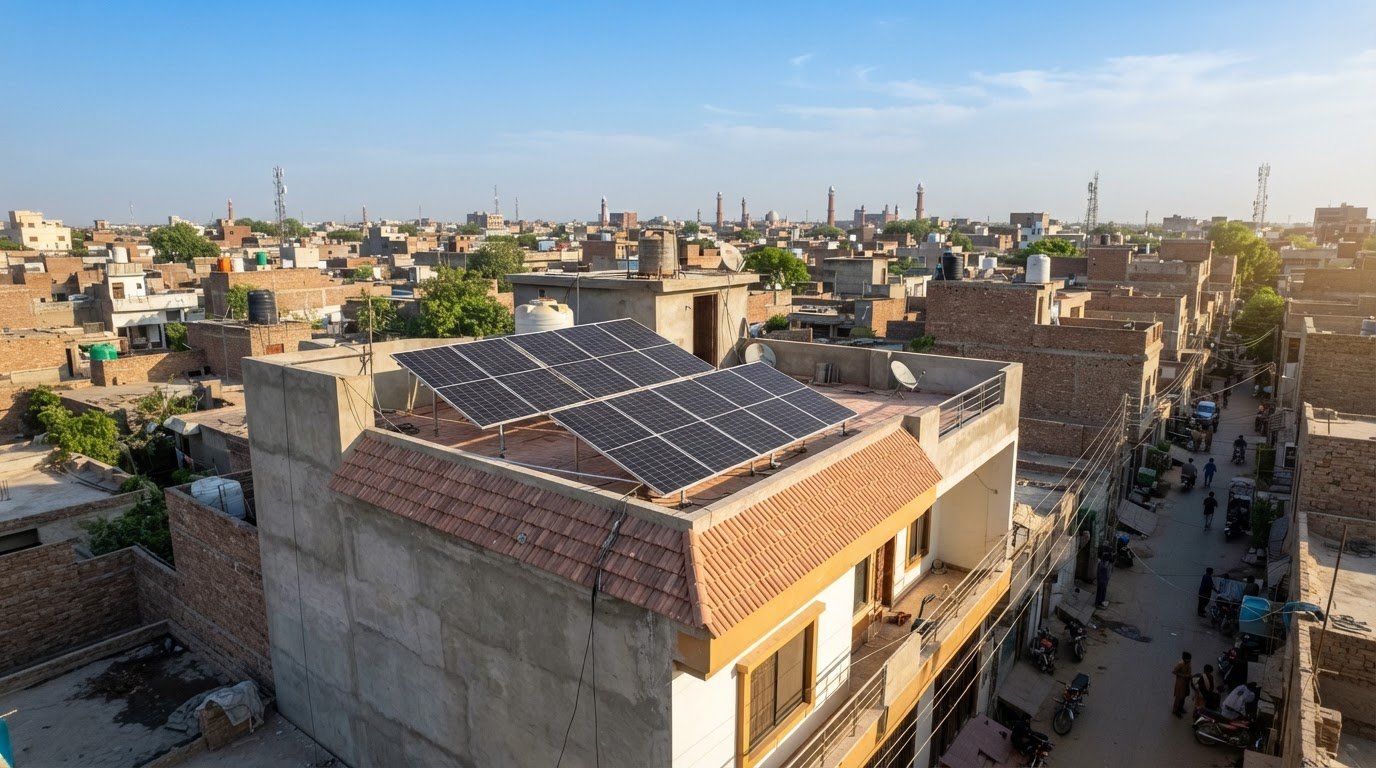
By Hamza | Updated 22 November 2026 | Solar Ka Ghar
A 5kW solar system can be a suitable starting point for some Pakistani homes, but the right choice depends on the electricity bill, daytime usage, roof space, shading and whether the household wants battery backup. The phrase “5kW system” describes the approximate rated capacity of the solar array or inverter; it does not guarantee a fixed number of units every day or a fixed reduction in the electricity bill.
Quick answer: There is no single reliable nationwide price for every 5kW installation. The total quotation changes with panel and inverter brands, system type, structure, protection equipment, installation quality, battery inclusion, city and warranty. Get at least three itemised written quotations on the same specification before comparing prices. This guide explains what should be included and how to estimate savings without relying on an outdated price claim.
What does a 5kW solar system mean?
A kilowatt (kW) is a measure of power capacity. A 5kW solar array has a combined panel rating of approximately 5,000 watts under standard test conditions. Actual output at a particular moment will vary with sunlight, panel temperature, shading, orientation, dust, wiring and inverter behaviour. A 5kW inverter and a 5kW panel array are also not automatically the same thing, so ask the installer to list both ratings.
A typical grid-connected package may include solar panels, an inverter, mounting structure, DC and AC cables, isolators, breakers, surge protection, earthing, installation and commissioning. A hybrid package may add battery storage and backup wiring. Some quotations include these items while others price them separately. That is why a headline price alone is not enough for a fair comparison.
What affects the price of a 5kW system in Pakistan?
| Price factor | Why it changes the quotation |
|---|---|
| Solar panels | Brand, model, wattage, efficiency, warranty and availability affect the equipment cost. |
| Inverter | On-grid and hybrid models differ in features, battery compatibility, monitoring and backup capability. |
| Battery | A battery can add a substantial cost depending on chemistry, usable kWh, power rating and warranty. |
| Mounting structure | Roof type, height, material, wind exposure and installation complexity affect the structure. |
| Electrical protection | Correctly rated breakers, isolators, surge protection, cables and earthing are part of a safe installation. |
| Labour and location | Transport, roof access, city, site conditions and workmanship scope can change the final amount. |
| Warranty and service | Local support, replacement arrangements and installer responsibility should be included in the comparison. |
Why this guide does not quote one fixed market price
Solar equipment prices can change with exchange rates, import costs, stock, brand and supplier. Two systems described as “5kW” may use different panel models, inverter types, structures and protection equipment. A low quotation may exclude installation items or after-sales service that another installer has included. Publishing one unsourced price as if it applies across Pakistan would therefore be misleading.
For a useful current estimate, ask local installers for written quotations dated within the same week. Ask each company to quote the same panel capacity, inverter category, structure, protection and installation scope. Record whether the amount includes taxes, transport, net-metering or prosumer application support where applicable, and any battery. Then compare the total installed price rather than only the equipment subtotal.
A comparison table to use when collecting quotations
| Item to compare | Installer A | Installer B | Installer C |
|---|---|---|---|
| Quotation date | Enter date | Enter date | Enter date |
| City and site survey | Enter details | Enter details | Enter details |
| Panel brand and exact model | Enter model | Enter model | Enter model |
| Total panel capacity | Enter kW | Enter kW | Enter kW |
| Inverter type and model | On-grid / hybrid | On-grid / hybrid | On-grid / hybrid |
| Battery included? | Yes / No; usable kWh | Yes / No; usable kWh | Yes / No; usable kWh |
| Structure and protection | List included items | List included items | List included items |
| Warranty and service | Write terms | Write terms | Write terms |
| Total installed price | Enter written amount | Enter written amount | Enter written amount |
Do not leave important cells blank when making your final decision. If one supplier has not included a battery, do not compare its total directly with a hybrid quotation that includes storage. Ask each installer to provide a second quote with the same configuration.
How much electricity can a 5kW system generate?
A 5kW array does not produce 5kW continuously from sunrise to sunset. Its output rises after sunrise, usually peaks around the middle of the day and falls toward sunset. Clouds, haze, dust, high panel temperature, shading, roof direction and tilt all affect production. Winter and summer output patterns can also differ.
A rough planning calculation can be made using peak-sun-hours and a system performance factor, but those inputs should be location-specific. For illustration only, if a 5kW array receives five equivalent peak-sun-hours in a day and the overall performance factor is 0.80, estimated energy would be 5 × 5 × 0.80 = 20 kWh for that day. This is not a guaranteed daily output or a promise for every city or season. Ask the installer to show the assumptions and a monthly estimate for your roof.
A proper site survey should check nearby buildings, trees, water tanks, parapet walls and other sources of shade. Even partial shading on a panel string can reduce output depending on the module layout and inverter design. Ask whether the quotation includes a shading assessment and a proposed panel layout.
How can you estimate your electricity-bill savings?
The value of solar energy depends on when your home uses it. Electricity consumed directly from the panels can reduce the amount you need to buy from the grid. Surplus electricity exported to the grid is treated according to the current prosumer regulations and the applicable export-credit mechanism. Imported units and exported units should not be assumed to have the same rupee value.
To estimate your own savings, use your recent bills and, if available, hourly or interval consumption data. Identify the daytime load, the evening load and the likely amount of solar generation that will be used directly. Then ask the installer to show the value of direct self-consumption separately from the value of exports. The calculation should use the tariff and export-credit method that apply to your connection.
- Collect at least three recent electricity bills.
- Write down which appliances run during daylight hours.
- Estimate how much solar power will be used immediately and how much may be exported.
- Use the current applicable import tariff and export-credit rules.
- Include fixed charges, taxes and other bill components where relevant.
- Compare the estimated annual benefit with the full installed cost and maintenance.
Do you need a battery with a 5kW system?
Not every 5kW installation needs a battery. A basic on-grid system may suit a household that mainly wants to use solar during the day and does not require backup. A hybrid inverter and battery may be appropriate when selected appliances need to run during outages or when storing daytime surplus is financially worthwhile.
Battery sizing should begin with the appliances you want to back up and the number of hours they need to operate. Lights, fans, a router and a refrigerator are different from running several air conditioners, a pump and electric cooking appliances. Check usable battery capacity, continuous discharge power, surge rating, warranty, compatibility and replacement cost.
Remember that many ordinary grid-tied inverters shut down during a grid outage for safety. Do not assume that rooftop panels will continue to power the house during a load-shedding event unless the system has a properly designed backup function. Ask the installer to identify which circuits will remain live and demonstrate the changeover operation.
On-grid or hybrid: which quotation should you choose?
| Your priority | Option worth comparing | What to check |
|---|---|---|
| Lower initial cost and daytime savings | On-grid system | No battery included; outage behaviour and export approval requirements. |
| Backup for selected appliances | Hybrid system with a battery | Backup output, battery capacity, surge rating and protected circuits. |
| Use more daytime surplus after sunset | Hybrid system with storage | Battery cost, energy shifted, efficiency losses and export credit avoided. |
| Operate without a reliable grid connection | Off-grid or hybrid with suitable backup | Seasonal energy balance, battery autonomy and any generator support. |
What should be included in a professional installation?
- Panel brand, model, quantity, wattage and product warranty.
- Inverter brand, exact model, rated AC output and warranty.
- Mounting structure material, roof anchoring and weather protection.
- Correctly rated DC and AC cables, isolators and circuit protection.
- Surge protection, earthing and lightning-protection assessment where required.
- Installation, testing, commissioning and monitoring setup.
- Written scope, payment milestones, after-sales contact and warranty claim process.
Ask for serial numbers and invoices for major components. Check that the equipment delivered to your property matches the quotation. A written handover should include the system layout, operating instructions, shutdown procedure and the installer’s service contact.
How to avoid common solar-buying mistakes
- Do not choose a supplier on the lowest headline price alone.
- Do not accept an energy-generation promise without written assumptions.
- Do not compare an on-grid quotation with a hybrid quotation as if they were identical.
- Do not ignore roof shade, structure strength or cable and protection quality.
- Do not assume old net-metering payback calculations apply to a new connection.
- Do not pay the full amount before the agreed equipment and installation milestones are met.
- Do not accept vague warranty language; ask who handles claims and where service is available.
Related reading: Is Solar Still Worth It After Net Billing
Frequently Asked Questions
| Question | Answer |
|---|---|
| What is the current price of a 5kW solar system in Pakistan? | There is no single nationwide price. It depends on panel and inverter models, on-grid or hybrid design, battery inclusion, structure, protection equipment, installation and city. Compare recent itemised quotations. |
| How many units can a 5kW system generate per day? | Output varies by location, season, roof direction, shading, panel temperature and system losses. Ask for a site-specific monthly estimate and the assumptions behind it. |
| Does a 5kW solar system need a battery? | No. An on-grid system can operate without storage. A battery is useful when backup or shifting daytime solar energy into evening hours is important, but it increases the initial cost. |
| Can a 5kW system run air conditioners? | It depends on the air conditioners’ power demand, how many run together, solar output, inverter rating and whether a battery is available. Have the installer calculate the actual load. |
| How many panels are needed for 5kW? | It depends on the wattage of the selected modules. Divide the target array capacity by the panel wattage and confirm the final string layout is compatible with the inverter. |
| How do I compare solar installer quotations? | Compare the exact panel and inverter models, total capacity, battery, structure, protection devices, installation scope, warranty, service and total installed price. |
| Will a 5kW system eliminate my electricity bill? | Not necessarily. Night-time imports, fixed charges, taxes and the applicable export-credit mechanism can leave a payable amount. Savings depend on your usage pattern and system design. |
Final recommendation
A 5kW solar system can be a sensible option when its capacity matches your household’s real electricity use and roof conditions. The safest way to buy is to compare three like-for-like written quotations, check the equipment models and warranties, and ask for a realistic monthly generation and savings estimate. Avoid promises of guaranteed units, fixed payback periods or a zero bill. A well-designed system with clear documentation is a better investment than a cheap package with missing details.
Sources and further reading: NEPRA – Prosumer regulations and legal documents | U.S. Department of Energy – Homeowner’s guide to solar | NREL – PVWatts calculator for location-based solar estimates | NREL – Solar resource and performance research
Comments
One response to “5kW Solar System Price in Pakistan: Cost Factors, Units and Savings”
[…] reading: 5kW Solar System Price in Pakistan: Cost Factors, Units and Savings | Is Solar Still Worth It After Net […]